
Dick Turpin's Grave
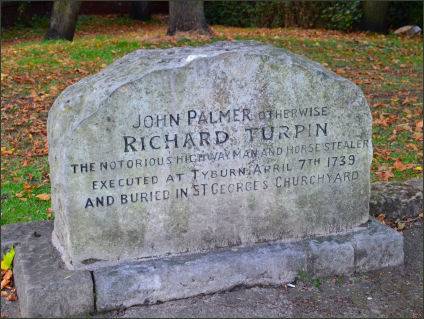 Opposite St. George's Church in York which stands not far from Walmgate Bar, lies a small graveyard which contains the last resting place of the notorious eighteenth century highwayman Dick Turpin.
Turpin's body was carried there for burial following his execution at the York Tyburn.
Opposite St. George's Church in York which stands not far from Walmgate Bar, lies a small graveyard which contains the last resting place of the notorious eighteenth century highwayman Dick Turpin.
Turpin's body was carried there for burial following his execution at the York Tyburn.
 Richard "Dick" Turpin (bapt. 1705 – 7 April 1739), the most famous highwayman of all time, was born at the Blue Bell Inn in Hempstead, Essex. He was the fifth of six children born to John Turpin and Mary Elizabeth nee Parmenter and was baptised there on 21 September 1705. John Turpin was a butcher and inn-keeper. Several accounts suggest that Turpin may have followed his father's trade as a butcher, in about 1725 he married Elizabeth Millington. After his apprenticeship the couple moved north to Buckhurst Hill, Essex, where Turpin opened a butcher's shop.
Dick Turpin was a violent man who progressed from deer stealing, to burglary, to highway robbery, and even murder, he probably became involved with the Essex gang of deer thieves, also known as the Gregory Gang, in the early 1730s. The members of the gang moved away from poaching to robbery. On 8 February 1735 Read's Weekly Journal reported one infamous attack at Traps Hill, in Loughton :-
'On Saturday night last, about seven o'clock, five rogues entered the house of Widow Shelley at Loughton in Essex, having pistols. And threatened to murder the old lady, if she would not tell them where her money lay, which she obstinately refusing for some time, they threatened to lay her across the fire, if she did not instantly tell them, which she would not do. But her son being in the room, and threatened to be murdered, cried out, he would tell them, if they would not murder his mother, and did, whereupon they went upstairs, and took near £100, a silver tankard, and other plate, and all manner of household goods. They afterwards went into the cellar and drank several bottles of ale and wine, and broiled some meat, ate the relicts of a filet of veal. While they were doing this, two of their gang went to Mr Turkles, a farmer, who rents one end of the widow's house, and robbed him of above £20, and then they all went off, taking two of the farmer's horses, to carry off their luggage, the horses were found on Sunday the following morning in Old Street, and stayed about three hours in the house.'
When most of the Essex gang were captured by the authorities, Turpin turned instead to the crime for which he has gone down in history, highway robbery and soon had a bounty placed on his head. From a cave in Epping Forest, near London, he and another man, Thomas Rowden, held up people as they passed by.
As the authorities began to close in on Turpin, he hid in Epping Forest, where he was seen by Thomas Morris, a servant of Henry Thomson, one of the Forest's Keepers. When Morris made a foolhardy attempt to capture him on 4 May 1737, Turpin, armed with pistols, shot and killed Morris. A contemporary description describes him as:-
'about Thirty, by Trade a Butcher, about 5 Feet 9 Inches high, brown Complexion, very much mark'd with the Small Pox, his Cheek-bones broad, his Face thinner towards the Bottom, his Visage short, pretty upright, and broad about the Shoulders.....wears a blue grey coat and a light coloured wig".' An E-fit of Turpin, derived from such reports, was published by the Castle Museum in York in 2009.
 Dick Turpin then fled to Yorkshire under the alias of John Palmer, ometime around June 1737 Turpin boarded at the Ferry Inn at Brough, under the alias of John Palmer. Turpin features in Harrison Ainsworth's romantic novel 'Rookwood', published in 1834. It describes Turpin making the ride to York. Historians argue that such a ride was really made by John Nevison, known as "Swift Nick" some 50 years before Turpin. Travelling across the River Humber between the the East Riding of Yorkshire and Lincolnshire, he posed as a horse trader, and often hunted alongside local gentlemen.
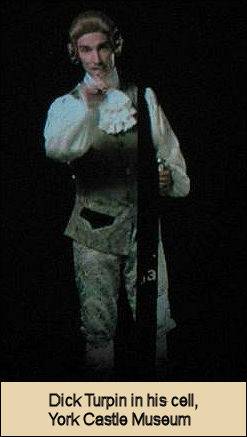
He was imprisoned at Beverley for shooting a man's cockerel and issuing threats to kill a man in October 1738 and was later transferred to York Castle jail when evidence emerged which linked him to more serious crimes. His true identity had formerly remained unknown until he wrote from his cell to his brother-in-law seeking aid. In the eighteenth century, postage was payable by the recipient of a letter, not the poster and Turpin's brother-in-law refused to pay the sixpence postage demanded. The letter was returned to the Post Office and there Turpin’s handwriting was recognised by John Smith, an employee there, who had taught him how to write at school. Smith travelled to York and identified Palmer as his former pupil, Dick Turpin for which he collected a £200 reward.
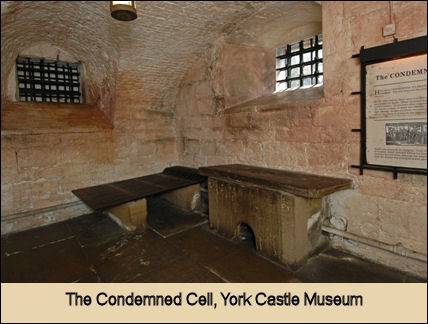
At the end of March 1739 he was tried at York Assizes, convicted and condemned to death, despite pleas from his father to have the sentence commuted to transportation. Before his execution, Turpin frequently received visitors, the gaoler was reputed to have earned £100 from selling drinks to Turpin and his guests, although he refused the efforts of a local clergyman who offered him "serious remonstrances and admonitions." The bleak condemned cell where he spent his last days can still be seen today, preserved in the Debtors' Prison of the York Castle Museum. John Turpin may have sent his son a letter, dated 29 March, urging him to "beg of God to pardon your many transgressions, which the thief upon the cross received pardon for at the last hour"
On Saturday, April 7, 1739, Turpin was taken from the jail and paraded through York with John Stead, a horse thief, in an open cart to the gallows at Knavesmire, he wore a frockcoat and shoes for the occasion as he wished to look stylish for his execution. He paid five mourners three pounds and ten shillings to follow his cart . Witnesses reported that he “behaved himself with amazing assurance” and "bow'd to the spectators as he passed".
Turpin spoke calmly to his executioner then threw himself off the ladder and was dead within five minutes. The York Courant 7 April 1739 account of Turpin's execution records "with undaunted courage looked about him, and after speaking a few words to the topsman, he threw himself off the ladder and expired in about five minutes.". His body was later laid out in the Blue Boar in Castlegate, where it attracted a crowd of curious spectators. It was soon after reported as stolen; however, the body-snatchers together with Turpin's corpse were soon apprehended and the body was reburied.