
Gillamoor
OS grid reference:- SE 683 900
 The attractive and tranquil village of Gillamoor is located around two and a half miles from the town of Kirkbymoorside on the edge of the beautiful North York Moors National Park. The unspoilt working village is pleasantly located on the summit of a flat toppped tabular hill. Sheep are regularly herded through the unspoilt village.
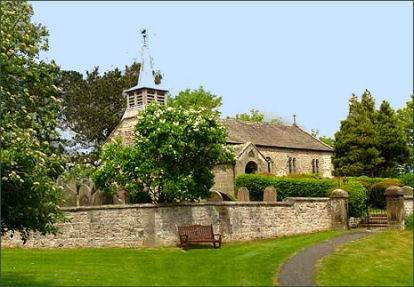
 The small attractive village church of St. Aidan (pictured left) stands right on the edge of a moorland escarpment, dropping sharply for 150 feet to the River Dove and the southern entrance to Farndale. It was rebuilt single-handedly in 1802 by local stonemason James Smith of Farndale using stone from the dismantled medieval church in Bransdale. The building was restored in 1880, and furnished by Temple Moore in 1908.
A church has occupied the site since as far back as the twelfth century. The present church consists of a simple rectangular structure with a nave and chancel and a porch at the western end of the south wall and an attractive bellcote at the western end of the building. The church is windowless on the north and west sides, reckoned a necessary safeguard against the prevailing winds.
The rough hewn font possibly dates to the Norman era and the seventeenth communion table, communion rails and wooden screens at the rear of the church came from the mother-church in nearby Kirkbymoorside. The colourful west window depicts the church's patron saint St Aidan of Lindisfarne (died 651), an Irish monk and missionary credited with restoring Christianity to Northumbria. He founded a monastic cathedral on the island of Lindisfarne, served as its first bishop, and travelled ceaselessly throughout the countryside, spreading the gospel to both the Anglo-Saxon nobility and to the socially disenfranchised and became known as Apostle of Northumbria.
At the side of the church is an old sunken lane which leads to a site which a medieval mill once occupied. The mill at Gillamoor was referred to in a charter of King John of 1206. It ceased to operate in late Victorian times.
 Just to the left of St Aidan's church is Gillamoor's justly famous panoramic 'Surprise View'. The church wall plaque reads:-
'Thou, who hast given me eyes to see and love this sight so fair, give me a heart to find out thee, and read thee everywhere.'
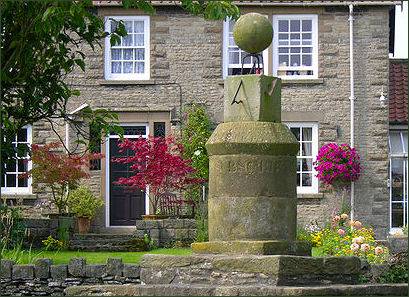
The War Memorial stands on the small but pretty triangular village green. An unusual, complex, four-faced sundial (pictured left) surmounted by a finely carved stone globe, a Grade II listed structure, stands by the roadside in the centre of Gillamoor. It was erected August 27th 1800 by John Russell by public subscription.
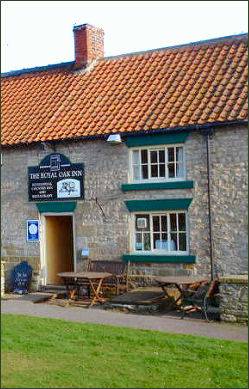
The stone built village pub, the Royal Oak Inn (pictured above right) dates back to the mid-seventeenth century and is a Grade II listed building. It was formerly roofed in thatch which was replaced by the present red tiles which are traditional in this area. The inn retains many attractive period features, boasting open log fires and oak beamed ceilings. The Royal Oak serves cask ales and excellent cuisine, which is all cooked fresh to order. High standard accommodation is also provided.
The village also has a school and a small Methodist church which dates to 1867. Nearby Farndale's show of spring daffodils is an irresistible attractions for visitors to the village.